
AI Marketing Glossary: Key Terms Explained

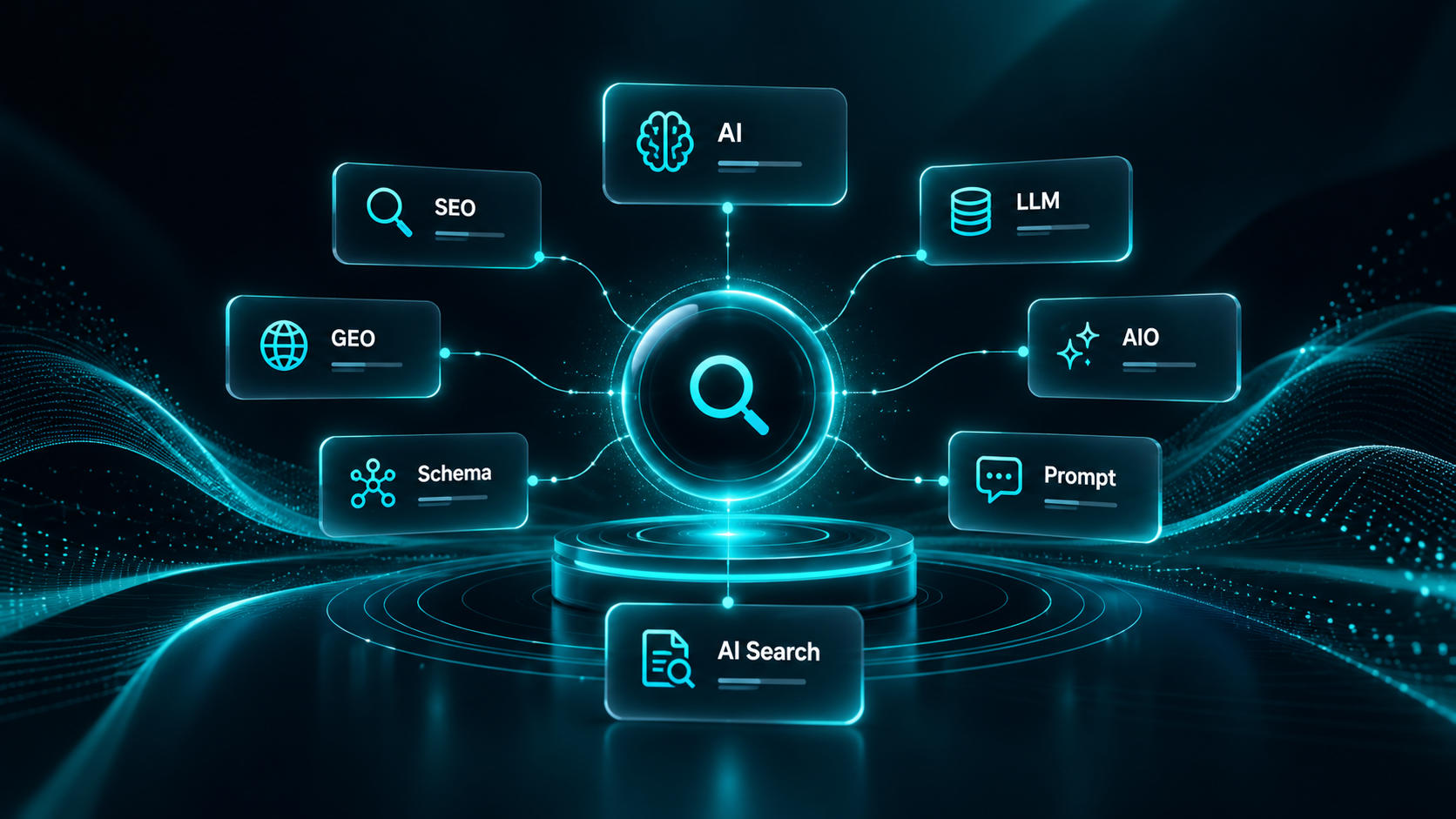
AI terminology is becoming a bigger part of everyday digital marketing conversations. But the growing number of acronyms and technical terms can be hard to keep up with, even for experienced marketers.
We've put together this glossary to explain the key terms in plain English, with practical examples to help you make sense of it all.
Jump to a category:
- AI basics: Core concepts and terminology
- AI tools & platforms: The tools you’ll hear about
- AI search and optimisation: Techniques for improving AI visibility
- AI visibility & measurement: Tracking how brands appear in AI search
AI basics
AI agent / Agentic AI
AI systems that can work towards a goal by planning and carrying out tasks, using tools and making decisions with varying levels of human involvement.
AI hallucination
When an AI system generates information that appears convincing but is inaccurate or fabricated.
Example: You ask ChatGPT for a restaurant’s opening hours, and it confidently tells you the restaurant is open on Mondays when it’s actually closed.
Artificial Intelligence (AI)
Technology that enables computers and machines to perform tasks that typically require human intelligence, such as understanding language, recognising patterns, making predictions and solving problems.
Generative AI
A type of AI that creates new content, such as text, images, audio or video, based on patterns learned from existing data.
Large language model (LLM)
A type of AI model trained on large amounts of text to understand and generate human language. LLMs power tools like ChatGPT.
Prompt engineering
The practice of designing and refining instructions given to an AI system to guide its responses and improve the relevance, accuracy and usefulness of its outputs.
Example: A marketer gives ChatGPT detailed instructions about their target audience, brand tone and content goals, then adjusts the prompt to get a more suitable response.
Retrieval-Augmented Generation
A technique that allows AI systems to retrieve information from external sources, such as websites or databases, and use it to generate more relevant, informed responses.
AI tools & platforms
ChatGPT
An AI assistant developed by OpenAI that can answer questions, generate content and help users research topics, solve problems and complete a range of tasks.
Claude
An AI assistant developed by Anthropic that can generate content, analyse documents, answer questions and assist with research and other tasks.
Gemini
Google's family of AI models, also available through its Gemini AI assistant. It can answer questions, generate content, analyse information and help users complete tasks.
Google AI Overviews
AI-generated summaries that appear in Google Search results for certain queries, bringing together key information from relevant sources and often linking to websites for further reading.
Google AI Mode
A conversational search experience within Google Search that lets users explore complex topics, ask follow-up questions and receive AI-generated answers with links to relevant sources.
Perplexity
An AI-powered search and answer platform developed by Perplexity AI that lets users ask questions in natural language and receive responses supported by links to relevant sources.
AI search and optimisation
AI Optimisation (Artificial Intelligence Optimisation / AIO)
A broad term for improving a brand's visibility and representation across AI-powered search and discovery experiences, including tools such as ChatGPT and Google AI Mode.
AI Search
The use of artificial intelligence to help people find information, explore topics and receive answers, through AI-generated summaries, conversational interfaces and other AI-powered search features.
Answer Engine Optimisation (AEO)
The practice of optimising content to provide clear, relevant answers that can be surfaced directly in search results and by AI-powered answer tools.
Entity
A distinct, identifiable person, place, organisation, product or concept that search engines and AI systems can recognise and associate with relevant information.
Generative Engine Optimisation (GEO)
The practice of improving how a brand, website or its content is discovered, referenced and represented in generative AI responses.
Search Engine Optimisation (SEO)
The process of improving a website's visibility in organic search results on platforms such as Google and Bing.
How do SEO, AEO, GEO and AI Optimisation differ? These terms overlap, and their definitions aren’t universally agreed upon. SEO generally focuses on visibility in traditional organic search results, while AEO and GEO describe approaches to improving visibility in AI-powered answers. AI Optimisation is often used as a broader term covering these activities.
Query Fan-Out
A technique used by some AI search systems to generate multiple related searches from a single question, gathering information across different topics and sources to build a more complete response.
Example: Someone asks an AI tool for the best family SUV in New Zealand. The system may search separately for safety ratings, fuel efficiency, pricing and reviews before generating an answer.
Structured data / schema markup
Standardised code added to a webpage to help search engines understand its content, such as products, organisations, articles and events. Schema markup is a common way of implementing structured data.
Zero-click search
A search where someone gets the information they need directly from the search results or an AI-generated answer, without clicking through to another website.
AI visibility & measurement
AI Citations
References or links to websites and other sources that AI tools include in their generated responses to support the information provided.
AI Search Tracking
The process of monitoring a brand's presence in AI-generated responses over time, including mentions, citations and visibility compared with competitors, across selected prompts and AI platforms.
AI Share of Voice
A measure of a brand's share of appearances in AI-generated responses relative to competitors, based on a defined set of prompts, platforms and other measurement criteria.
Example: A New Zealand tyre retailer finds that its brand appears in 30% of ChatGPT responses to a set of relevant customer questions, compared with 50% for a leading competitor.
Brand Mentions
When an AI tool names or refers to a brand, business or product in its generated response, with or without a link to its website.
Wondering where your business stands in AI search?
Understanding the terminology is one thing. Knowing what it means for your business is another. If you're curious about your visibility in AI search and where the opportunities might be, we're happy to talk it through.
Further reading
Want to explore some of these topics in more detail? Take a look at our articles for practical insights into AI search, brand visibility and how these tools work.
Why your business isn't showing in AI Overviews

Explore why some businesses are missing from Google's AI-generated summaries and what can improve their visibility.
How to get your business mentioned in ChatGPT

Learn what influences brand mentions in ChatGPT and how to strengthen your online presence.
How AI hallucinations hurt your business

Understand why AI tools sometimes get things wrong and what inaccurate answers can mean for your brand.
Got time for more?
Here’s a snapshot of the guidance and insights we provide on our blog.

If we’re not a fit, we’ll recommend someone we trust to deliver what you need.