
AIO vs SEO vs PPC (Paid Ads): How to Win Search Visibility in 2026

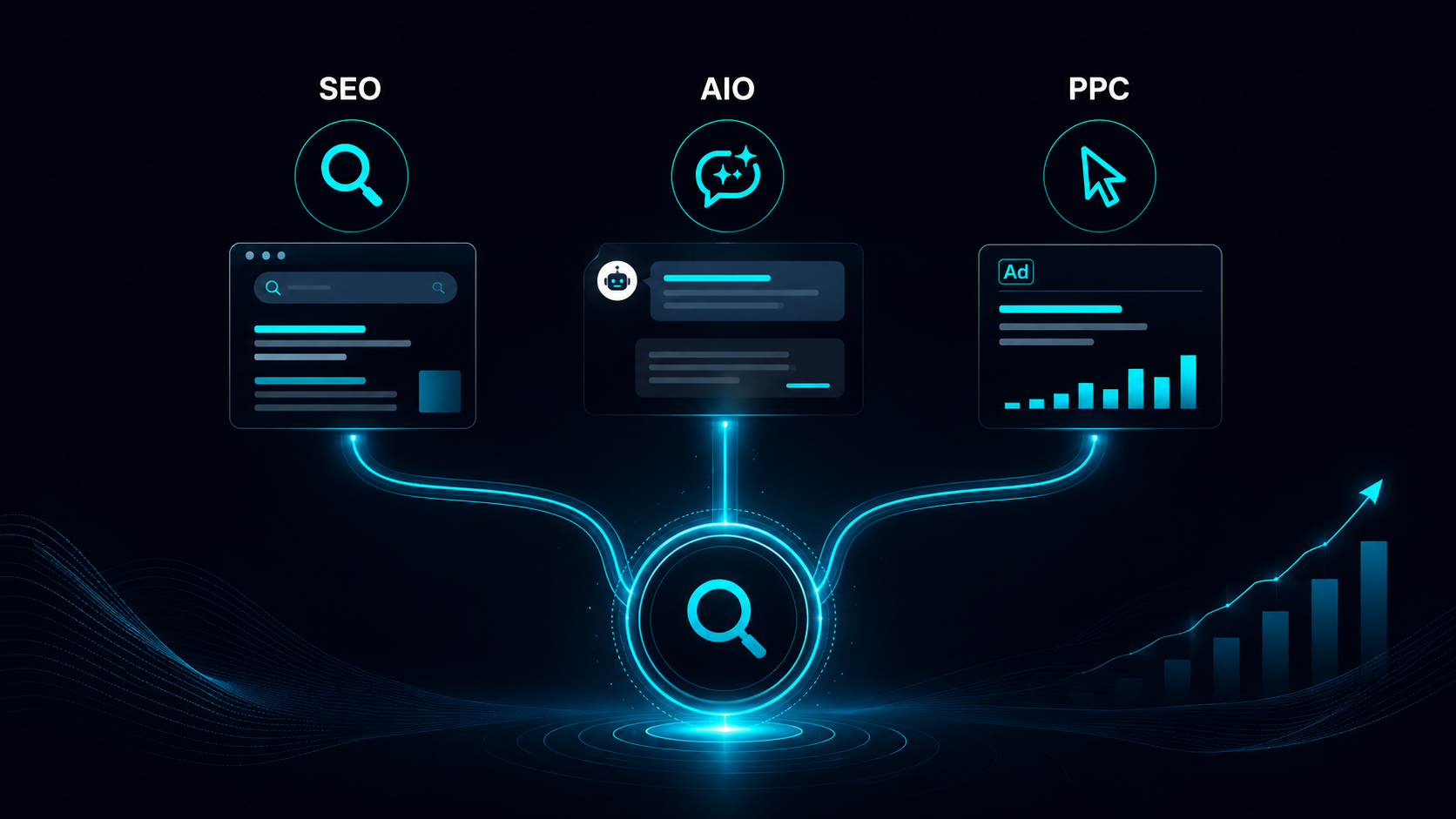
In 2026, your customers are moving between traditional search engines and AI generated answers to find the information they need. So what does that mean for your search strategy, and where do paid ads fit in?
The key is understanding how these platforms all fit together and aligning them into a cohesive digital marketing strategy that makes the most impact.
Let’s explore how to use each channel to your advantage, and where to focus to get the best results.
Where people are searching in 2026, and what it means for your business
Despite headlines about AI taking over traditional search, the numbers tell us that Google is still where most people start information discovery. It currently holds close to 90% of search market share with competitors like Bing trailing well behind. This means visibility on Google is still the most reliable way to capture demand and drive consistent traffic to your website.
But we can't ignore that search behavior is changing and businesses need to adapt their strategies to reflect this. AI-powered platforms like Gemini, Claude, and Copilot are seeing rapid adoption, while Chatgpt.com has already become the fifth most visited website globally.
This means your content must be structured to satisfy both Google’s algorithms and the conversational requirements of generative assistants.
How SEO, AI and Paid Ads work together
SEO, AI-driven discovery, and paid ads are increasingly intertwined. Activity in one channel can influence performance in another.
The most effective strategies recognise this overlap and treat SEO, AI optimisation, and paid ads as complementary parts of a broader search visibility approach.
SEO builds the foundation
SEO remains the infrastructure that everything else builds on. It’s what allows your content to be discovered, understood, and trusted by search and generative AI engines.
Good SEO builds the foundation for visibility by making it easier for platforms to crawl, interpret, and prioritise your content. This could be achieved through:
- Technical optimisation (crawlability, site speed, mobile performance)
- Keyword research aligned to user intent
- Clear site structure and internal linking
- Structured data and schema markup
- High-quality, authoritative content that genuinely answers questions
- Earning backlinks and third-party credibility signals
AI introduces a new visibility layer
While SEO provides the foundation for online visibility, the way that visibility shows up is starting to change.
AI-generated summaries now appear at the top of many Google’s search results, often appearing above organic listings and even paid ads. In many cases, the overview answers the question immediately, and for the user, the search ends there. This means if your content isn’t being surfaced or referenced in these AI-generated responses, you risk losing visibility even if you’re ranking well in traditional search results.
The rise of AI optimisation, and its place in search strategy
This shift is what’s driving the need for AI optimisation (AIO, also known as GEO - Generative Engine Optimisation).
AI optimisation (AIO) builds on the same foundations as SEO, but shifts the focus from just ranking pages to being included, referenced, and surfaced within AI-generated answers. The content that performs well in AI Overviews is typically the same content that performs well in search.
The difference is in how it’s structured and understood. Instead of targeting isolated keywords, content needs to clearly answer questions, connect related topics, and provide enough context for AI systems to interpret and extract meaning confidently.
In practice that means:
- Answering key questions directly and early within your content
- Using clear headings and logical structure to make information easy to extract
- Demonstrating expertise and trust signals (author, brand, consistency)
- Covering topics in depth, rather than creating thin, keyword-focused pages
- Maintaining consistent messaging across your website and third-party platforms
In simple terms:
SEO: Earning your position in a list of links on traditional search results pages.
AIO: Earning presence inside the answer itself.
AIO depends on a good SEO foundation. Without strong technical performance, authority, and content quality, your site is unlikely to be trusted or surfaced by AI systems in the first place.
Are you visible in AI search?
Find out how your brand is being represented on ChatGPT, Gemini, and Claude.
👉 Our AI optimisation service is available as a standalone project or an add-on to your SEO or paid search programmes.
Paid search accelerates and protects demand
So where do paid ads fit into an AIO and SEO strategy?
Despite the rapid rise of AI-driven search experiences, PPC continues to be one of the most reliable ways to get your business in front of people.
Earning consistent visibility in organic search and AI tools takes time. You don’t get cited in AI responses or appear at the top of competitive search results overnight. Authority, trust signals, and rankings are built gradually.
Investing in paid ads is where you can make up for that lost visibility, particularly while your organic and AI presence is still gaining momentum.
If you’re struggling to rank for high priority keywords, a paid ad campaign can accelerate your visibility and allow you to secure top-of-page real estate immediately. For competitive commercial terms, that immediate exposure can mean the difference between capturing demand and losing it to a competitor.
You can use paid ads to:
- Target your most important SEO content if it hasn’t started ranking organically yet.
- Run tests to find out if keywords and messaging resonate, before investing in more marketing for a topic.
- Retarget users who found your site through organic search but didn’t convert.
- Dominate the SERP with both PPC and SEO content. This tactic is great for making sure you always rank at the top for your most important keywords.
Of course, the real value of an ads campaign comes from what happens after the click.
For paid ads to turn into conversions and generate revenue, the quality of your content and website pages must match the promise of your ad. That’s where SEO and AIO do heavy lifting.
Need to see results quickly?
Get new customers from paid ads on Google, Meta, and LinkedIn with a paid search strategy.
See our PPC advertising services →
Improving ROI across paid ads, AIO, and SEO
Whether someone finds you through an ad, a Google search, or an AI tool, your website is still where many buying decisions happen. That means your landing page content has a significant impact on the return you get from every marketing channel.
When your landing page content clearly matches what people are looking for, and delivers on what your ads or search results promise, visitors are more likely to stay, take action, and convert. That leads to stronger campaign performance, lower ad costs, and a better return on your marketing spend.
On top of that, when people spend more time on your site and take action, it sends positive signals back to Google and other platforms, helping you show up more often.
The result is that your marketing becomes more efficient: good content helps every channel perform better, lowers your cost to get customers, and increases your return on investment.
How to prioritise your search strategy
When every channel feels important, and there’s pressure to be visible everywhere, it can be difficult to know where to begin.
You don’t need to tackle everything all at once to be effective. The key is knowing where to focus first, and how that decision supports what comes next. You can expand your approach over time, starting with the most urgent need.
What you prioritise will ultimately depend on your business goals.
Start with SEO / AIO if you’re building for the long term
If your focus is long-term growth, start with your foundations.
That means getting the basics right, like site performance, structure, and crawlability.
From there, focus on making your content clear, well-structured, and authoritative so it’s easy for AI to understand and surface.
By getting the fundamentals of Google Search right first, you create a foundation that naturally feeds into the AI platforms.
Is your content built for how people search today?
Copywriting is included as part of our SEO service. We create content designed to perform across both traditional search and LLMs.
Explore our SEO copywriting service
Start with PPC if you need immediate results
If you need leads, traffic, or sales immediately, paid ads are the fastest way to get there.
PPC puts you in front of high-intent searches straight away, even if you don’t yet have strong organic visibility. It’s also a good way to test what messaging and offers actually work.
The trade-off is that visibility stops when spend stops, so it works best when paired with a plan to build organic and AI visibility over time.
For maximum impact, combine SEO, AIO, and PPC
If you have the means to invest more broadly, all three strategies work best together.
- Use SEO to build long-term visibility and authority.
- Build on your SEO work with content specifically optimised for AI search.
- Layer in PPC to accelerate and protect demand.
Let’s build your multi-layered search strategy
If you’re ready to show up in rankings, in AI answers, and in front of high-intent buyers, let’s create a smarter search strategy together.
The authentic team brings together SEO, PPC, and AI-led thinking to help businesses stay competitive and show up in the right places.
Book a no-obligation meeting with us today and we’ll help you figure out what’s worth doing next.
Got time for more?
Here’s a snapshot of the guidance and insights we provide on our blog.
.png)

If we’re not a fit, we’ll recommend someone we trust to deliver what you need.